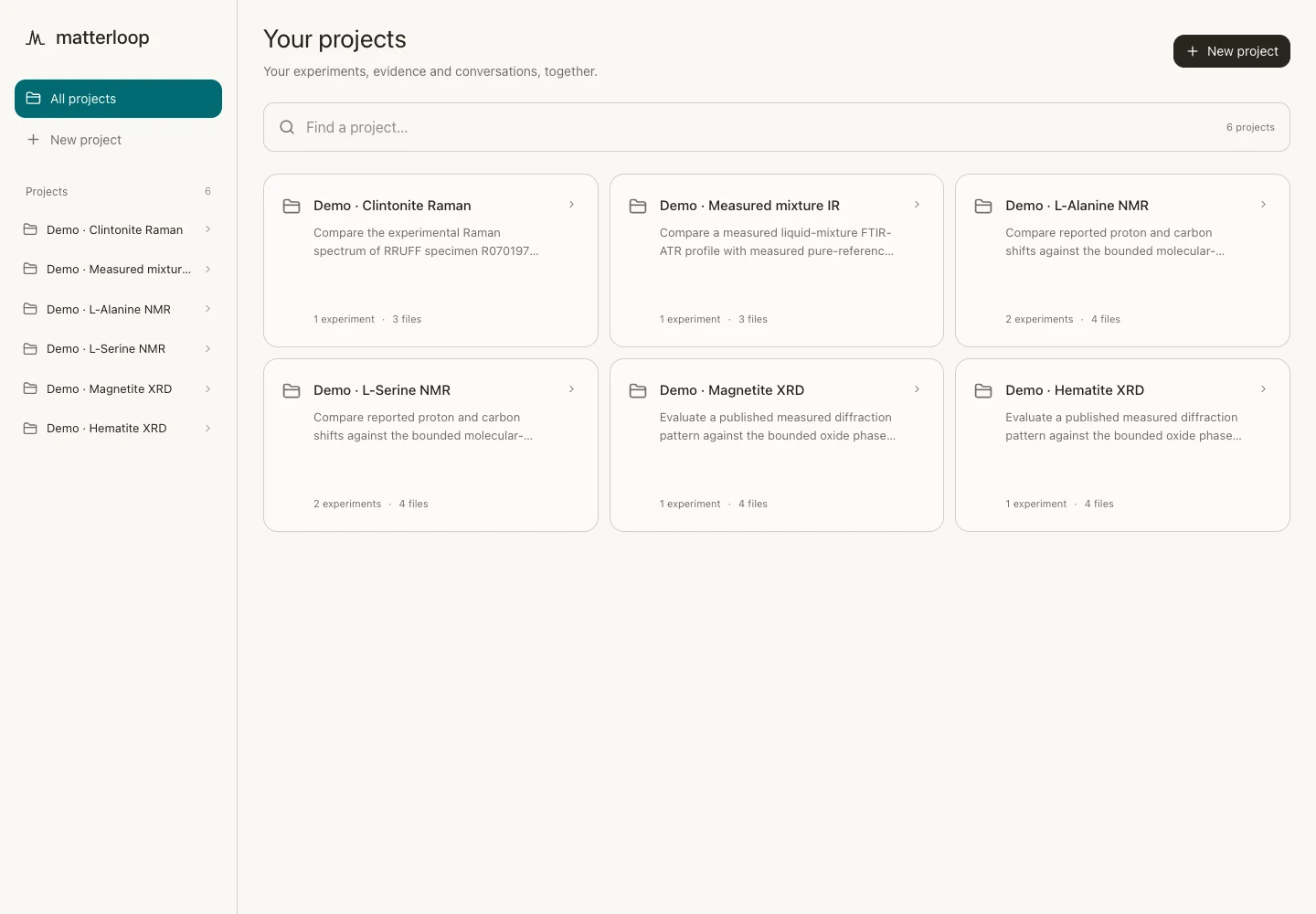
Your projects, experiments and documents, together.Actual product screenshots · Public-data demos
THE WHOLE EXPERIMENT, IN CONTEXT
All your experiments. One place to think.
Start with a question. Bring in the evidence. Keep the interpretation, conversation and next step connected.
01 / PLAN
Start with your question.
Projects with a purpose
Name a project and define its objective, hypothesis and evidence criteria.
Experiments and measurement checklists
Create experiments in each project. Attach documents and prepare a downloadable experiment plan and checklist.
The right documents, in the right place
Keep shared protocols and notes at project level, with experiment-specific documents alongside their data.
02 / INTERPRET
Understand the measurement.
Data belongs to its experiment
Upload XRD, NMR, IR or Raman files with acquisition details. See the instruments you have actually uploaded.
Plots, matches and mismatches
Explore interactive measurements, ranked candidates, reference comparisons and the evidence that remains unexplained.
Analysis history and scientific review
Revisit saved interpretations and record a scientist’s review separately from the original engine result.
03 / ASK
Think with your evidence.
Project and experiment chat
Ask across a whole project or focus on one experiment. Keep independent conversations with automatic chat names.
Hypotheses and next experiments
Explore possible explanations and measurements that could distinguish them. Turn a proposed next step into an experiment.
Sources and agent activity
Follow cited measurements, documents and logs. See which evidence the assistant used and where information is missing.
04 / RECORD
Keep the reasoning, too.
Experiment logs
Record your observations, conclusion, outcome and next step against a saved snapshot of the experiment’s evidence.
Written reports, automatically
Logging an experiment queues a cited report draft for review. Export the saved report as PDF, Markdown or JSON.
Evidence-based project decisions
Review supporting, contradictory or inconclusive evidence against your criteria, then record a proceed, revise or stop decision.
FOUR INSTRUMENTS. DEFINED SCIENTIFIC TASKS.
Different measurements. A connected workflow.
Each method has its own analysis and reference library. Candidate rankings and AI interpretations remain open to scientist review.
XRDPhase identification
Compare diffraction patterns with supported crystalline phases. Inspect reference agreement, missing reflections and unexplained peaks.
NMRStructure consistency
Check reported 1H and 13C chemical shifts against supported molecular candidates. This workflow uses shift lists; raw FID processing is outside its current scope.
IRMixture interpretation
Compare a measured spectrum with measured pure-component references. Inspect proposed components, the fitted profile and residual; fit weights are spectral coefficients.
RamanMineral reference matching
Rank supported mineral references against a measured Raman spectrum, with specimen provenance and acquisition details where recorded.
Account sign-in
Create an account and return to your own projects and saved conversations.
Visible AI allowances
Daily limits keep chat and report usage bounded. Scientific processing and downloads do not use that AI allowance.
Originals and reusable outputs
Download original measurements and export analyses as PDF, CSV or JSON, with source hashes and processing provenance.
LESS ADMIN BETWEEN EXPERIMENTS
What could that time add up to?
Try an example calculation for the work around an experiment.
Adjust the assumptions to match your lab.
Per experiment45 min50% of the example workflow
Across your week7.5 hoursAt 10 experiments per week
Edit the time assumptions +
Assumed active minutes per experiment, including human
review
Task / minutes
Manual
With Matterloop
Find files & context
Interpret & review
Write the report
Record & plan next steps
Total active time
90 min
45 min
Example estimate, not measured performance: (90 − 45) × 10 ÷ 60 =
7.5 hours/week. Includes scientist review; excludes sample
preparation, instrument time and waiting for results. Actual time
saved will vary.
Your data informs the answer. Your judgment makes the decision.
About the research preview +
Each instrument has a defined task and a limited reference
library. Candidate rankings are not calibrated probabilities or a
complete structure determination. AI proposals and report drafts
require scientist review. Independent scientific validation is
ongoing.
The current software is a single-lab research preview. Selected
questions and retrieved evidence excerpts are sent to the
configured AI provider. It does not automate laboratory work.